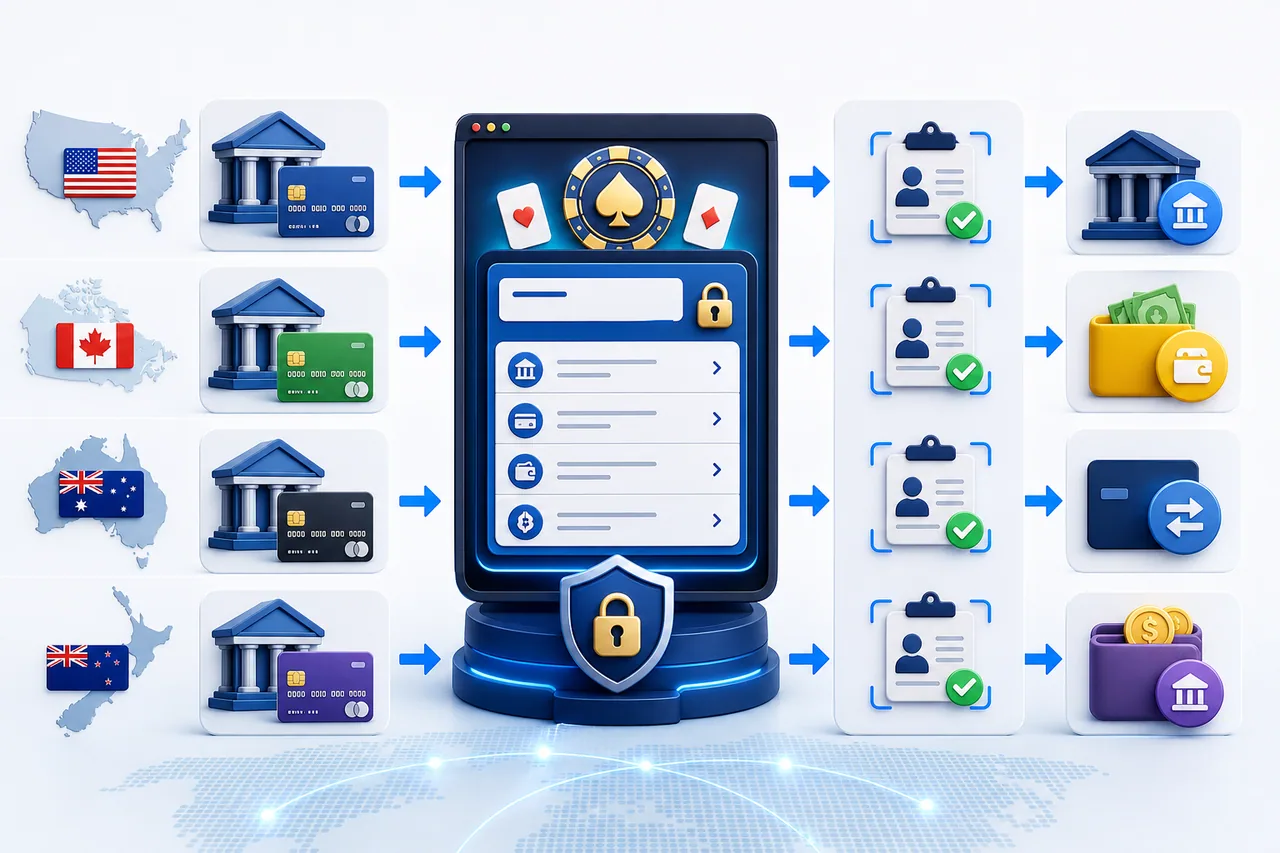
Compare country-specific casino deposit methods, withdrawal methods and local banking routes. Each guide explains the account currency, payout direction and payment options that may require a separate withdrawal method.
One deposit can create four different payout decisions
The same card, bank account or wallet can behave differently after the casino, provider and location rules are applied. Start by confirming the locally relevant operator, then trace the funding method through identity checks to the receiving account that will handle the withdrawal.
This route view is the fastest way to spot a deposit-only method, a currency conversion, an unsupported payout destination or a verification step that could delay access to approved funds.
Compare the complete money route—not just the payment logo shown at deposit.
Country directory
Choose a country payment guide
Start with your location, then compare the methods that may appear at locally relevant casino cashiers. Availability still depends on the operator, provider, account and local rules.
USState-dependent
United States
Compare state eligibility, eCheck/ACH, debit card acceptance, cash deposits and operator-specific payout routes.
Compare the payment routes most relevant to each market, then open the country guide for local banking, withdrawal, verification and currency details.
On a small screen, swipe horizontally to compare all columns.
Country-specific casino deposit methods, withdrawal routes and local currency details
Country
Local currency
Main deposit routes
Withdrawal routes
Deposit-only and local focus
United States
USD
eCheck/ACH, eligible debit cards, PayNearMe and supported wallets.
ACH/eCheck, supported wallets, card payouts or cash at cage where offered.
Retail cash funding may need another payout route. Availability varies by state.
Canada
CAD
Interac, Instadebit, iDebit, cards and supported e-wallets.
Interac where supported, e-wallets and bank-based alternatives.
Prepaid vouchers are commonly deposit-only. Province and operator context matters.
Australia
AUD
Payment access depends on the service, provider and current Australian rules.
The operator's terms define the payout route and available consumer protection.
ACMA regulatory guidance comes before payment-method comparison.
New Zealand
NZD
Cards, bank transfers, wallets and prepaid vouchers where offered.
Bank transfer, a supported wallet or another verified payment route.
Prepaid vouchers usually need a separate payout method. Licensing is rolling out in stages.
Use the country guide alongside the casino's current cashier and withdrawal menu for the most relevant account-level view.
Payment direction
Casino deposit methods vs withdrawal methods
A deposit method moves money into the casino account. A withdrawal method must also be able to receive money in the account holder's name. That difference shapes the complete payment route.
Money in
Casino deposit methods
Cards, bank payments, e-wallets, prepaid vouchers, mobile billing and retail cash products can all be used to fund an account where supported.
The deposit side usually focuses on acceptance, local currency and the amount the player wants to transfer.
Money out
Casino withdrawal methods
Bank transfers, supported e-wallets, card payouts and other verified routes may receive casino withdrawals.
The payout side also involves payment ownership, identity verification and the currency sent to the receiving account.
Why this matters:A familiar deposit option can still lead to a different withdrawal route. Choosing both sides together gives the player a clearer payment plan.
One-way payment routes
Which casino payment methods are deposit-only?
Deposit-only methods fund a casino account but normally send winnings through another approved route. The exact setup comes from the casino and payment provider.
Prepaid vouchers
Paysafecard, Neosurf, Flexepin and CASHlib are designed around prepaid deposits. A bank account or e-wallet commonly handles the payout.
Mobile billing
Boku and pay by mobile place the deposit on a phone bill or mobile balance. Winnings cannot be credited back to the phone bill.
Retail cash funding
Cash-based products such as PayNearMe can fund an account through a participating location. The casino may use ACH, a wallet or another supported route for withdrawals.
Operator-specific card and wallet setups
A card or mobile wallet may appear for deposits while its payout feature is unavailable at that casino. The withdrawal menu shows which receiving routes are enabled for the account.
Payment matching
How the casino same-method withdrawal rule works
Casinos often connect a withdrawal to the method used for the deposit. This creates a continuous transaction record and helps match the payment account to the casino account holder.
When the original method can receive payouts, the cashier may return funds through that route. If the deposit came from a voucher, mobile bill or cash product, the casino can present a verified bank account, card payout or e-wallet as the receiving method.
The country guide and individual payment guide should be read together because the available fallback route changes by market and operator.
1Deposit
The player funds the account with a prepaid voucher.
2Casino balance
The deposit and any eligible winnings appear in the account.
3Payout route
The cashier offers a verified bank or e-wallet withdrawal.
4Receipt
The receiving account gets the approved withdrawal in its supported currency.
Country screening framework
Five gates decide whether a casino payment route fits a country
A country label is only the beginning. Before comparing familiar logos, check the legal market, the local payment rail, the account owner, the currency path and the receiving method. A route that fails one gate can still accept a deposit while creating a poor or unusable withdrawal.
01
Market gate
Identify the regulator, licensed-market directory or official transition rule that applies where the player is physically located. Do not infer permission from a cashier logo, an app-store listing or a local-currency balance.
02
Rail gate
Name the actual rail: ACH in the United States, Interac in Canada, PayID in Australia, or a New Zealand bank and open-banking route. The brand shown by the casino may be only the front end.
03
Ownership gate
The funding account, casino profile and payout destination should identify the same player. A spouse's card, shared wallet or business account can convert a simple payment into a source-of-funds review.
04
Currency gate
Follow the currency from deposit amount to casino balance and back to the receiving account. One conversion on the way in and another on the way out can cost more than a visible transaction fee.
05
Exit gate
Open the withdrawal menu before funding. Confirm which destination can receive the deposit amount, which route handles winnings, what limits apply and what reference will trace a sent payment.
Best cross-country rule:
Choose backwards. Start with the verified account that should receive the withdrawal, then select a compatible deposit method. Deposit speed is useful only after the exit is clear.
Local rail glossary
The same payment category behaves differently in each market
“Bank transfer” is not one universal casino method. In a US cashier it may mean an ACH debit for the deposit and an ACH credit for the withdrawal. In Canada, a familiar Interac label can refer to a bank-authenticated deposit, an e-Transfer instruction or a separate payout product. In Australia, PayID is an identifier linked to a bank account and payments usually travel through the domestic fast-payment infrastructure. In New Zealand, direct bank transfer, POLi, Online EFTPOS and newer open-banking experiences use different credential and approval models.
This distinction matters when something goes wrong. A player cannot trace an ACH credit through Interac, ask PayID to reverse a payment as if it were a card chargeback, or assume an NZ checkout using bank authentication can receive casino withdrawals. The correct support path begins with the rail and the institution that actually holds the account.
United States: state gate, then ACH
A regulated-state player may see eCheck, online banking or instant bank transfer labels that ultimately rely on a bank-account connection. ACH can support credits and debits, but the casino interface, verification vendor and payout product decide whether both directions are enabled. Retail cash and many cards solve only the funding side.
Interac is the most important local clue, not a complete answer. Confirm whether the withdrawal returns through Interac, another bank transfer or a verified wallet. Bank-set limits, operator limits and CAD currency handling must be checked separately.
PayID makes domestic account-to-account payments convenient, but Australian Payments Plus warns about illegal online gambling scams using the rail. ACMA's service rules and blocked-site information belong ahead of every speed or convenience comparison.
The Online Casino Gambling Act 2026 created a staged transition. Provider eligibility, public registers and payment availability will change as the system moves toward licensing. POLi NZ, Online EFTPOS and ordinary bank transfer should be identified separately rather than grouped as one “instant banking” option.
A “fee-free deposit” can still produce an expensive route. Record each value below before ranking payment methods.
Cost point
Question to answer
Evidence to keep
Common mistake
Funding charge
Does the casino, provider or bank charge a fixed or percentage deposit fee?
Cashier quote and bank tariff
Reading “casino fee: zero” as total cost: zero
Deposit conversion
Which party converts the home currency into the casino account currency?
Quoted rate, source amount and credited balance
Allowing dynamic conversion without comparing the rate
Withdrawal charge
Is there a fee per request, a free-request allowance or an intermediary-bank deduction?
Withdrawal terms and final request screen
Splitting a payout into several fee-bearing requests
Receiving conversion
Will the destination receive USD, CAD, AUD or NZD directly?
Receiving-account currency and provider quote
Paying a second conversion after an avoidable first conversion
Cash-out leg
Does a wallet or prepaid account charge to move funds to the player's bank?
Wallet tariff and withdrawal receipt
Stopping the comparison when funds reach the wallet
The lowest visible deposit fee is not automatically the lowest final cost. Compare the amount that reaches the player's normal spending or savings account.
Deposit-only failure map
Four ways a quick deposit creates a difficult payout
The voucher has no receiving account
A prepaid code can cap the amount exposed at deposit, but the code usually cannot receive winnings. The casino then needs a verified bank, card or wallet destination. If that destination is added only after a win, ownership checks can begin at the slowest possible moment.
The retail cash route ends at the counter
Retail cash products can serve players who do not want to enter card details online. The barcode or cashier receipt proves funding, not a payout destination. Keep the receipt and confirm the digital or venue-based withdrawal route before handing over cash.
The card accepts purchases but not payouts
Card authorization proves that one purchase message passed the issuer's controls. It does not prove that the card programme accepts merchant credits or original-credit transactions from that operator. An eligible debit card can be useful; an unsupported card needs a bank or wallet fallback.
The local rail is only a deposit connector
Some cashiers display a local bank brand to make the deposit familiar, then use a different system for withdrawals. This is not automatically a problem when the fallback is disclosed and same-name. It becomes a problem when the operator cannot name the route, fee, limit or ownership evidence until after the deposit.
Worked decisions
How the right answer changes by country
These scenarios show the decision logic without pretending that every casino or bank offers the same cashier.
US
Cash deposit, digital withdrawal
A player uses a retail cash barcode because a debit card is declined. Before paying, the player verifies state eligibility and adds a same-name ACH account for withdrawals. The cash receipt supports the funding record; ACH provides the receiving route. Buying a second barcode would not fix a withdrawal problem.
CA
Interac deposit, unclear payout label
A Canadian cashier shows Interac at deposit but only “bank transfer” at withdrawal. The player asks whether the payout uses Interac e-Transfer, a processor-led bank credit or manual account details, then confirms CAD receipt and bank limits. The method is judged by that answer, not the deposit logo.
AU
PayID recipient looks unfamiliar
An Australian-facing site supplies a unique PayID, but the recipient name does not match the operator or a disclosed processor. The player stops before sending, checks ACMA information and contacts the bank if the site appears suspicious. Payment speed cannot compensate for an unidentified recipient.
NZ
Provider status changes during transition
A New Zealand player previously used a provider that now falls into a new regulatory milestone. Before depositing again, the player rechecks DIA guidance, provider status, NZD support and the withdrawal destination. A saved cashier screenshot from last month is evidence of the old route, not proof of current eligibility.
Editorial verdict:
The highest-opportunity country payment question is not “which method is instant?” It is “which verified route still works for this player, in this market, in both directions, at an acceptable final cost?”
Maintenance advantage
A useful country guide separates stable principles from volatile facts
Some payment principles are durable. The receiving account should belong to the verified player. Deposit acceptance does not prove withdrawal support. Final cost includes conversion and cash-out. Legal market status comes from an official source, not from a payment logo. These principles can remain consistent across the cluster.
Other details require a date. Operator authorization, country access, cashier labels, bank participation, transaction limits, fees and regulatory transition milestones can change. Each country page therefore names the source and review date near the claim that depends on it. A future update should revise that narrow fact without flattening the entire page into generic warnings.
This maintenance model also prevents keyword cannibalization. The hub answers how country changes the decision. The US page owns state and ACH questions; Canada owns Interac and CAD; Australia owns ACMA and PayID safety; New Zealand owns the 2026–2027 transition and NZD bank routes. Provider-specific mechanics remain on the payment pages, while problem pages handle pending withdrawals, declined deposits, fees, limits and method mismatches.
Readers get a clear path instead of five versions of the same article. Search engines get distinct intent, original country evidence and meaningful internal links. The editorial team gets a practical update queue built around facts that actually change.
Research and verification
How this country hub is maintained
The PayMethod Guide Editorial Team reviews public regulator guidance, official operator directories and payment-provider documentation. Country pages record the date of each editorial review and link to market-specific sources where they help explain local payment conditions.
These sources provide the regulatory and payment context used in this guide.
Common questions
Casino payment methods by country FAQ
Why do casino payment methods differ by country?
Provider coverage, banking rules, operator policy, local regulation, currency support and identity checks vary by market. A method shown at one casino or in one country may be unavailable or deposit-only elsewhere.
Which casino payment methods are deposit-only?
Prepaid vouchers, mobile billing and some cash funding routes are commonly used for deposits rather than payouts. The casino may provide a verified bank account or e-wallet as the withdrawal route.
Can I deposit with one method and withdraw with another?
Many casinos return funds through the original payment route where possible. When the deposit method cannot receive a payout, the cashier may offer a verified bank account, card payout or e-wallet instead.
What is the casino same-method withdrawal rule?
The same-method rule links a withdrawal to the payment route used for the deposit. It helps the casino confirm payment ownership and maintain a clear transaction record. A different payout route may be used when the original method is deposit-only.