
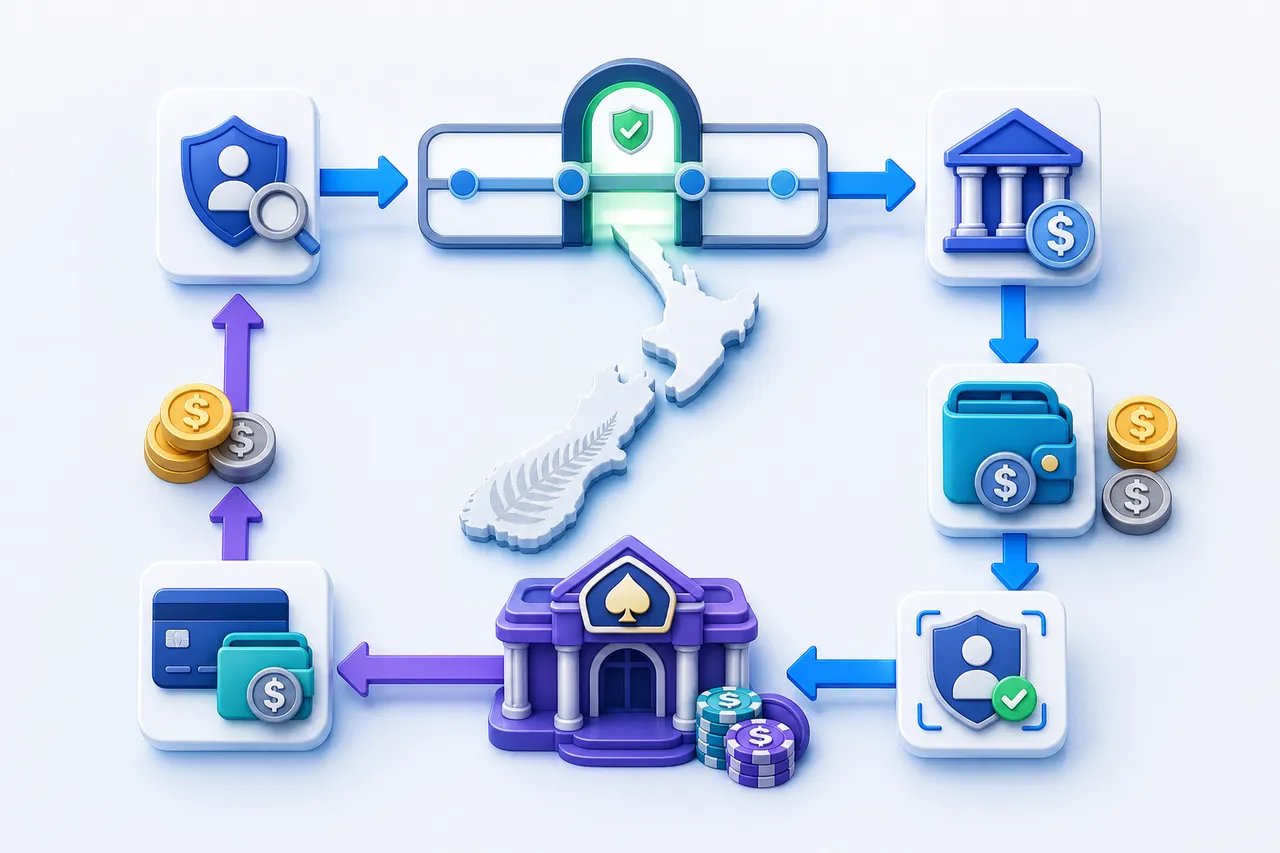
Verify the provider today, then build the payment route
The Online Casino Gambling Act 2026 is in force, but the licensed market is being introduced in stages. DIA says there is no immediate change for players during the current transition, while only operators that provided services before 1 May 2026 may continue under the transitional rules and advertising is prohibited. From 1 December 2026, the provider position changes again, with the full licensing system expected to operate in 2027.
That timetable makes stale “NZ-friendly” labels especially weak. Check DIA first, then inspect the current deposit and withdrawal menus. The safest practical route keeps the provider status, payment ownership, currency and payout destination aligned.
New Zealand's 2026 online casino transition
Act commenced
The new law entered into force and the advertising prohibition began. Existing-provider transition rules apply.
Expressions of interest opened
DIA opened the first licensing-process stage for providers seeking a place in the new system.
Operating restrictions change
Providers that have not applied for a licence must cease operating; applicants can continue under the stated exemption while assessed.
Licensed regime expected
DIA expects to begin issuing licences and bring the regulated system fully into operation.
These dates describe the official rollout as reviewed on July 19, 2026. They are not a permanent operator list. Recheck DIA guidance before relying on any site claim or making a payment later in the transition.
New Zealand casino payment method comparison
| Method | Deposit role | Withdrawal role | Best fit | Check first |
|---|---|---|---|---|
| Bank transfer | Direct account funding | Strong receiving route where supported | Clear ownership and larger transfers | Processing time, bank details and currency |
| Debit or credit card | Fast and familiar where accepted | Card payouts are not guaranteed | Simple deposits | Issuer policy and fallback withdrawal |
| E-wallet | Account-based funding | Can be a fast receiving route | Two-way payment separation | NZ availability, fees and bank cash-out |
| Prepaid voucher | Fixed-value funding | Usually deposit-only | Strict deposit budget | Verified bank or wallet payout |
| Mobile wallet | Convenient card-backed deposit where visible | Often not a direct payout destination | Fast mobile funding | Underlying card and withdrawal support |
Bank routes are predictable; cards are convenient; wallets sit between
Bank transfer: fewer identity handoffs
A bank account in the player's name creates the clearest ownership trail. It is our strongest NZ route when the casino supports both directions and the transfer remains in NZD. The tradeoff is speed: casino approval and bank delivery can each add time.
Cards: strong deposit UX, uncertain payout fit
Cards can confirm a deposit quickly, but a card logo in the cashier does not mean the same card can receive funds. Check the withdrawal menu and issuer currency fee before choosing card convenience over a complete bank route.
Wallets: useful only when the cash-out is included
A wallet can separate casino activity from the main bank interface and may receive payouts faster after approval. Compare the cost and time to move funds from the wallet to a New Zealand bank account; that final transfer is part of the withdrawal experience.
Plan the New Zealand withdrawal before the deposit
Confirm name, NZD support, deposit limit and any provider fee.
Use the same method where possible or a verified bank or wallet fallback.
Resolve identity and payment-ownership checks before an urgent request.
Voucher and mobile-wallet deposits deserve extra attention because the visible deposit product may not receive money. If the operator cannot state the fallback route, limit and verification requirement before funding, choose a clearer method.
NZD support prevents hidden double conversion
A casino may display an NZD amount while the payment account settles in another currency. Ask three questions: what currency leaves the funding account, what currency the casino ledger uses and what currency reaches the withdrawal account. A conversion on both entry and exit can cost more than an advertised payment fee.
The lowest limit across the operator, payment provider and bank controls the route. For a planned larger withdrawal, compare the payout ceiling and any rolling limit before assuming the fastest deposit method is also the best value.
KYC and operator review sit before network speed
Payment delivery begins only after the operator releases the withdrawal. Identity, address, payment ownership and source-of-funds checks may happen first. The casino account, card, bank and wallet should use the same legal name. Third-party deposits and mismatched addresses create avoidable delays.
A direct editorial verdict is more useful than an “instant payout” label: choose the cashier that shows verification requirements and pending status clearly. A fast wallet cannot repair a slow or opaque operator approval stage.
Which New Zealand payment route should you choose?
Choose bank transfer if…
You want the clearest ownership trail and a route suited to receiving approved withdrawals.
Choose a wallet if…
It supports both directions and the wallet-to-NZ-bank fee remains competitive.
Choose a card if…
Deposit convenience matters and the separate payout route is already confirmed.
Choose a voucher if…
You deliberately want a fixed deposit amount and accept a different verified withdrawal method.
New Zealand payment advice needs a date attached
The Department of Internal Affairs states that the Online Casino Gambling Act 2026 is in force, while the licensing system is being implemented in stages and is not expected to be fully operational until 2027. DIA's player guidance says existing providers operating before the transition cut-off can continue temporarily under stated conditions, and from 1 December 2026 only successful auction participants will be able to operate under an exemption while licence applications are assessed.
That timeline makes a permanent “accepted casino payments in New Zealand” table unreliable. A provider visible today may need to leave, apply, change its payment processor or alter its NZD cashier. The useful page records the date, names the milestone and tells the player what to verify again.
Compare New Zealand pay by phone casinos using a dedicated carrier-billing, NZD charge and withdrawal-route test.
Check current DIA player guidance
Confirm the latest transition status and advertising rules. Do not rely on an operator's promotional page as the legal source.
Identify the provider and route
Record the exact domain, account currency, funding rail and same-name withdrawal destination.
Recheck provider eligibility
A previous payment result does not prove the provider can continue through the next stage.
Use the public licensing information
When DIA begins issuing licences and publishes the relevant register, that source should replace transitional assumptions.
Save a dated screenshot for evidence, but verify live status before every new deposit. The old screenshot shows what happened; it does not authorize the next transaction.
POLi, Online EFTPOS and open banking are not interchangeable
Several competing casino pages claim that POLi New Zealand has closed. The official POLi NZ website checked on 2026-07-19 states that service continues uninterrupted for New Zealand merchants and customers. That does not prove acceptance by a particular casino, and POLi is generally a deposit route rather than a casino payout account. It does mean a responsible page should not publish a closure claim contradicted by the provider's current site.
Worldline's Online EFTPOS uses a different approval model. The payer selects a bank, enters a mobile number and approves a payment request inside the banking app. Worldline says the customer does not expose online-banking credentials to complete the payment. Availability depends on participating banks and the merchant implementing Online EFTPOS; the existence of the retail payment product does not prove casino availability.
Payments NZ describes open banking as a consent-based connection using industry API standards. It advises customers to authorize through the bank and never share online-banking usernames, passwords or security codes with another organization. This distinction is useful in a casino cashier: a modern bank redirect or app approval should be identified separately from a screen-scraping flow that asks the customer to enter credentials into a third-party interface.
| Route | Customer action | Casino withdrawal assumption | Verification point |
|---|---|---|---|
| POLi NZ | Follow the provider's supported bank-payment flow | Treat as deposit-only until the cashier proves otherwise | Official POLi status, live merchant route and bank terms |
| Online EFTPOS | Approve a request inside the participating bank app | Retail refund capability does not equal a casino withdrawal method | Worldline documentation, participating bank and live cashier |
| Open-banking payment | Grant consent through the bank's secure authorization | Confirm whether the same provider supports payouts | Bank redirect, consent scope and provider identity |
| Manual bank transfer | Send to named account using bank details and reference | Can support a separate bank payout when enabled | Beneficiary, reference, currency and same-name destination |
Measure what returns to the New Zealand bank account
An NZD cashier removes one source of uncertainty, but the player still needs to follow the final value. The bank may send NZD to a processor that credits another account currency. The casino may convert the withdrawal before sending it to a wallet. The wallet may then apply its own NZD cash-out rate. Each step can look small while the combined spread becomes material.
- Record the bank debit.Write down the exact NZD amount and any bank or payment-provider charge.
- Record the casino credit.Note the balance currency and effective rate if it differs from NZD.
- Price the withdrawal.Check the minimum, request fee, free-withdrawal allowance and currency that will be sent.
- Price the receiving method.Include wallet conversion, intermediary-bank deductions and cash-out cost.
- Compare final receipt.Rank methods by NZD reaching the bank, not by the number displayed in the casino account.
If the route needs two conversions, ask whether a direct NZD bank payout exists. For a smaller withdrawal, a fixed fee can dominate the result. For a larger withdrawal, a bank or operator cap can force multiple requests. The best method is the one that keeps the round trip understandable and within confirmed limits.
Prepare for a cashier change during the regulatory transition
A provider that changes status may remove a deposit method, alter withdrawals or ask customers to close balances. The correct response is not to make a final deposit to keep an account active. Stop new funding, complete identity checks through official channels, request the available balance and save the payment route offered for closure.
If the original method was deposit-only, ask for an approved same-name bank or wallet destination. If a provider announces an exit date, do not wait until the final day to discover that a document, currency conversion or minimum withdrawal blocks the request. A balance below the minimum should be addressed through written support, not by depositing more money merely to cross a threshold.
Before a provider or payment route closes
- Save the provider notice and exact effective date.
- Stop new deposits and cancel pending deposit attempts.
- Download transaction history and account statements.
- Complete legitimate KYC through the official account.
- Confirm the same-name NZD withdrawal destination.
- Request the balance early and keep the trace reference.
- Recheck DIA guidance for the relevant transition stage.
Three NZ payment decisions that generic templates miss
Casino shows POLi but no POLi withdrawal
The player confirms the official service remains current, uses POLi only if the live merchant route and bank permit it, and verifies a same-name NZ bank withdrawal before depositing. A deposit brand does not need to be the payout brand when the alternative is disclosed and approved.
Cashier claims “online EFTPOS” but requests credentials
The player stops because Worldline's documented Online EFTPOS flow uses approval in the bank app without exposing banking credentials. The player verifies the provider name and never enters passwords or security codes into an unexplained third-party form.
Wallet withdrawal arrives in another currency
The player compares the casino conversion, wallet balance currency and wallet-to-bank quote. A slower direct NZD bank route may preserve more value and create a simpler ownership trail.
These examples explain why “instant deposits” is a weak national verdict. The most important detail may be the provider's legal transition status, the credential model of the bank payment or the currency used after the casino sends the withdrawal.
Keep a dated route that survives a status change
- Regulatory record: DIA page, date checked and transition milestone.
- Provider record: exact domain, account ID, notices and current availability.
- Payment record: method name, processor, bank approval and transaction reference.
- Currency record: NZD source, casino balance, withdrawal currency and final NZD receipt.
- Ownership record: matching names across casino, bank and wallet.
- Withdrawal record: request, approval, initiation and receiving-bank trace.
The page should be reviewed again at each DIA milestone. That maintenance burden is a content advantage: a dated, source-led transition guide answers the real New Zealand question better than a generic global payment table.
The approval experience reveals which New Zealand bank route you are using
A modern bank-payment page should make the provider and authorization boundary understandable. In Worldline's Online EFTPOS model, the customer selects the bank and approves the request in the bank's app. In an open-banking model described by Payments NZ, the customer grants consent through secure bank authorization and sensitive credentials are not shared with the third party. POLi uses its own documented payment experience and should be checked against the official New Zealand service and the customer's bank terms.
Pause when a cashier uses a familiar label but the interaction does not match the provider documentation. An unexpected form asking for a full banking password, security code, remote-access installation or payment to “verify” a withdrawal deserves independent verification. Open the bank app directly, contact the bank and casino through known channels and do not approve a second request merely because the first one timed out.
Check amount and merchant
Read the request inside the bank app. Confirm the amount, payee and purpose before authorizing.
Check the destination
Verify that authorization occurs at the bank or identified provider, not an imitation page controlled by the merchant.
Check status before retrying
A duplicate approval can create two debits. Confirm the bank and cashier status first.
Credential design does not establish casino legality or withdrawal support, but it materially changes payment risk. It is one of the most New Zealand-specific questions the page can answer without pretending that every merchant supports the same rail.
Check the account again after the payment
After approval, confirm the bank debit, merchant reference and casino credit rather than closing every screen immediately. A bank request can be approved while the merchant fails to match the reference, and a casino can display a pending balance before final settlement. Saving both sides makes the difference visible.
If the casino credit is missing, do not repeat the payment until the bank and operator confirm the first attempt's status. Supply the amount, NZ time, reference and masked source account. If two approvals were submitted, report both and keep the balances untouched while support reconciles them. This careful follow-up is more useful than a generic promise that all NZ bank deposits are instant.
Official New Zealand sources used for this guide
- DIA: Online gambling information for players — current customer rules, transition and support.
- DIA: Licensing and compliance for providers — implementation stages and dates.
- DIA: Online Casino Gambling overview — regulatory programme and public updates.
- POLi New Zealand — current official service status for New Zealand merchants and customers.
- Worldline New Zealand: Online EFTPOS — bank-app approval, participating banks and credential model.
- Payments NZ: Open banking — consent, bank authorization and credential-safety guidance.
DIA information was checked on July 19, 2026. Recheck during the transition because provider eligibility and public registers will change.
New Zealand casino payment FAQ
Is online casino gambling regulated in New Zealand in 2026?
The Online Casino Gambling Act 2026 is in force and DIA is implementing the licensing system in stages. The full licensed regime is expected in 2027.
What is the best payment method for New Zealand players?
A verified bank or wallet route that handles both directions in NZD is the strongest practical option. Operator support still controls availability.
Can New Zealand players withdraw to a card?
Only where the operator and card network enable it. Otherwise, use the verified route shown in the withdrawal menu.
Why does NZD support matter?
It makes costs easier to see and can avoid conversion on both the deposit and withdrawal.
How should players check a provider during the transition?
Use current DIA player guidance, check the provider's position under the transition and recheck when the public licensing information changes.