
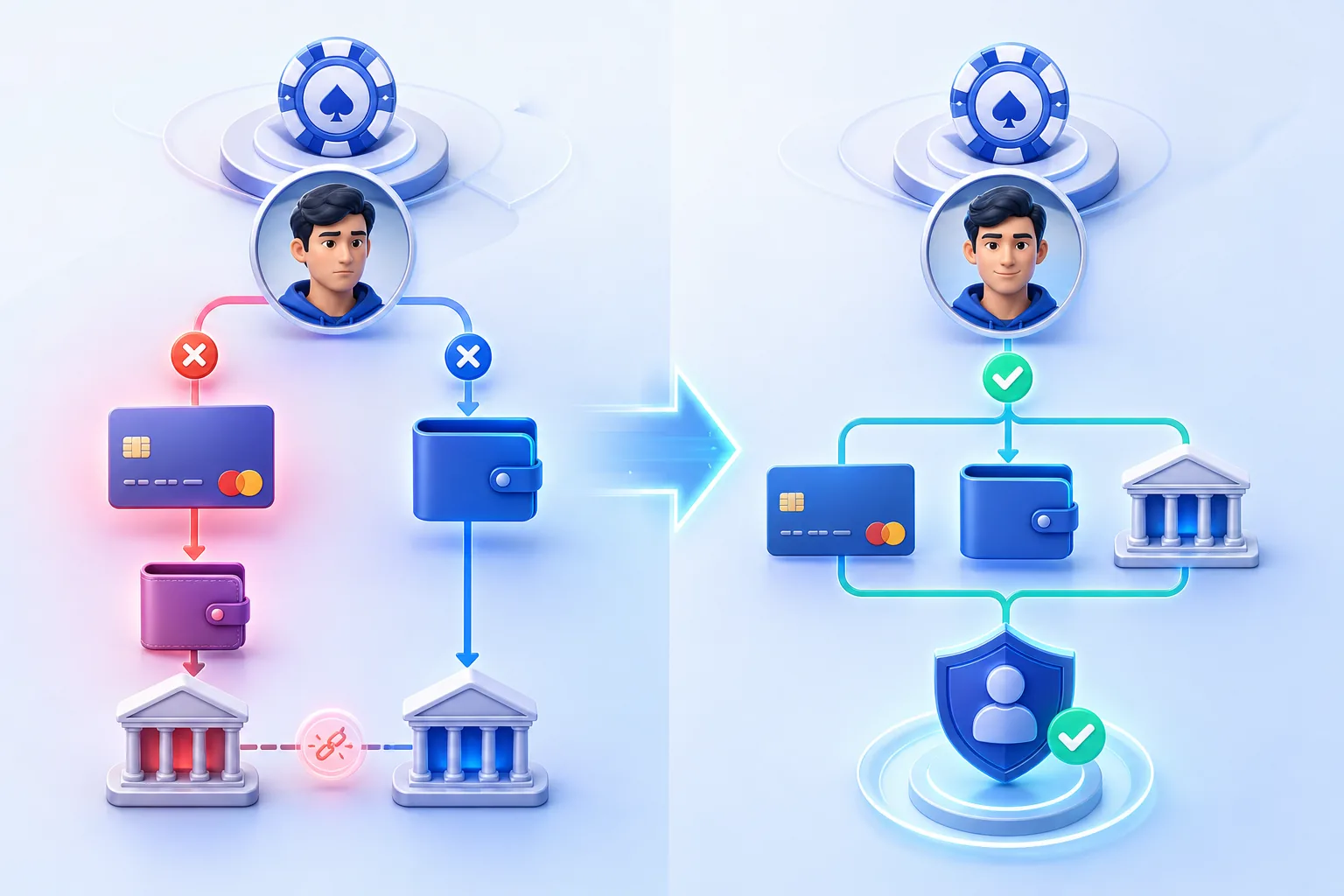
What a casino payment method mismatch actually means
A payment mismatch appears when the casino cannot confidently connect the verified player to the funding source or withdrawal destination. The difference can be obvious, such as another person’s card, or technical, such as a device-wallet token showing different digits from the physical card. It can also involve a changed surname, missing middle name, transliteration, joint bank account, wallet login email, expired card or closed bank account.
Start by separating identity from credential. The legal owner can match even when an email, card number or token changes. Official provider records should connect those credentials. If the legal owner does not match, do not manufacture linkage. Third-party funding can conflict with operator terms and trigger fraud or anti-money-laundering review; the resolution may involve refunds, account restrictions or a formal complaint depending on the facts and jurisdiction.
Stop adding methods while the mismatch is open. Each new card, wallet or bank account creates another owner and transaction to review. Build one chronology containing the casino profile name, source account owner, visible credential, destination owner, deposit references, any replacement or closure and the exact operator concern. Ask which field must be reconciled.
Different digits can still belong to one person.
Name change, token, replacement or joint account.
Do not alter documents or identities.
Approved by the operator in writing.
Name, credential and destination mismatches are different
Classify the mismatch before choosing evidence. The useful distinction is legal identity, account owner, login identifier and payment credential. A wallet email can differ from the casino email; a token can differ from card digits; neither proves a different owner. This matters because the wrong classification produces irrelevant or excessive documents.
Look for evidence at the point where the route changes hands. Ask support which field or owner failed and compare the provider profile with the casino profile. A status label or familiar payment logo cannot replace that record. A replacement card may retain the same underlying account while displaying a new number.
The practical response is to name the exact difference in one sentence. Provide the official record that connects it. Avoid sending a random stack of statements. That shortcut can hide the answer inside unnecessary data, while a documented route keeps the next request answerable.
Changed names, transliteration and joint accounts
Legitimate identity variations need a transparent bridge. The useful distinction is format variation and a different person. Marriage, order of names, diacritics, middle names and joint account formatting can cause automated mismatch flags. This matters because a system can compare text without understanding the legal relationship.
Look for evidence at the point where the route changes hands. Use identity, name-change or official bank-owner records appropriate to the difference. A status label or familiar payment logo cannot replace that record. A bank statement can list both joint owners while the casino shows one.
The practical response is to explain the variation and ask which canonical name the operator will use. Update inaccurate profile details through the formal process. Avoid cropping out a co-owner or changing a file. That shortcut can turn transparency into suspected manipulation, while a documented route keeps the next request answerable.
Tokenised wallets, replaced cards and expired funding methods
A changed credential can still belong to the original payment account. The useful distinction is visible card or token number and underlying owner relationship. Device wallets create network tokens; issuers replace cards after expiry, loss or fraud; closed credentials can still appear in casino history. This matters because return-to-source systems may reference the old credential.
Look for evidence at the point where the route changes hands. Obtain issuer or wallet records linking old and new endings to the same owner. A status label or familiar payment logo cannot replace that record. The casino can show the token’s last four digits while the bank statement shows the physical card account.
The practical response is to ask whether incoming credits map automatically or require a same-name fallback. Keep closure or replacement evidence. Avoid deleting the old method record or adding a stranger’s card. That shortcut can break the historical trail, while a documented route keeps the next request answerable.
Third-party deposits and withdrawals: the high-risk branch
A payment method owned by another person is not a harmless formatting mismatch. The useful distinction is same-owner evidence gap and true third-party funding. The casino can question who supplied funds, who controlled the transaction and who should receive money. This matters because these facts affect fraud, money-laundering and operator terms.
Look for evidence at the point where the route changes hands. Preserve the real statements and disclose the relationship without falsifying ownership. A status label or familiar payment logo cannot replace that record. The UK Gambling Commission has discussed cases where operators accepted third-party funding but examined it only at withdrawal.
The practical response is to stop further transactions and request the formal resolution, refund and complaint position. Use jurisdictional dispute channels if the process is unfair. Avoid creating duplicate accounts, borrowed wallets or edited statements. That shortcut can deepen restrictions and legal risk, while a documented route keeps the next request answerable.
A safe resolution path when the original method cannot receive funds
Use an operator-approved same-name fallback with evidence of why the original route is unavailable. The useful distinction is closed or incompatible original account and an unverified replacement destination. The operator may need closure evidence, payment history and ownership proof before rerouting. This matters because a new destination changes the payout risk after funding.
Look for evidence at the point where the route changes hands. Keep account closure, card replacement, wallet profile and written fallback approval. A status label or familiar payment logo cannot replace that record. A closed bank account can be replaced by another bank account owned by the same verified player.
The practical response is to get the allocation and destination in writing before submitting again. Request a trace if an earlier payment was already sent or returned. Avoid making a token deposit through the new method merely to force it into the menu. That shortcut can start new play or verification obligations, while a documented route keeps the next request answerable.
Mismatch records that make one owner visible across the route
Legal name is the anchor. Emails, tokens and card numbers are identifiers, not identities. Link them to the provider profile. Keep masked official proof.
History matters. A closed credential can explain a current difference. Preserve old and new endings with dates. Keep issuer notices.
Honesty limits damage. A third-party method cannot be converted into same-owner evidence. Disclose and request formal resolution. Keep every response.
A practical self-audit before you rely on this account and payment-owner resolution
Retell the route without using promotional labels. For this question, the relevant stages are casino identity, deposit owner, credential link, payout owner, evidence. If you cannot name the account, provider or record at one stage, mark it as unknown. An unknown is not automatically unsafe, but it is a decision cost: support must resolve it before the route deserves trust. The page verdict—map the casino legal identity to the funding source and payout destination. explain legitimate name, token or account changes with official records; disclose third-party funding honestly and use the formal resolution path.—should still make sense when every logo and speed badge is removed.
Check whether you are comparing the same event on both sides. The critical distinctions here are legal identity, account owner, login identifier and payment credential; format variation and a different person; visible card or token number and underlying owner relationship; same-owner evidence gap and true third-party funding; closed or incompatible original account and an unverified replacement destination. A casino term, payment-provider estimate and bank message may each be accurate while describing different parts of the transaction. Put the source beside the stage it controls. This prevents a provider’s broad capability from becoming an unsupported promise about one casino account, country or payout request.
Test the negative path as carefully as the successful path. Ask what happens if the destination rejects the payment, a document is unreadable, the original credential expires, a limit is reached or the account currency changes. The route is stronger when the answer identifies where funds are recorded, which reference proves the return and which same-owner fallback is allowed. “Contact support” is not a complete failure policy unless the support team can name those facts.
Finish with a stop rule. Decide in advance which evidence gap, unexplained delay, ownership conflict or payment request will make you pause rather than deposit or retry. Keep that rule separate from the emotional pressure of a bonus, expiring session or pending balance. Write down the official complaint channel, the account limit you will not exceed and the records you will preserve. If support changes the explanation, compare the new answer with that record instead of starting the whole story again. A good payment decision reduces the number of hurried choices required after money moves; it does not merely make the first click easier.
Repeat the audit whenever one material fact changes. A new payment method, replaced card, changed address, different currency, larger amount or newly requested document can create a route that only looks like the previous one. Date the new evidence and keep the old record so the reason for the change remains visible. Do not silently overwrite a destination or assume an earlier approval covers a new account. This version history helps the casino, provider and receiving institution discuss the same transaction instead of mixing several attempts together.
Compare one realistic alternative before committing. Use the same amount, currency, account owner and final destination, then count the handoffs, checks, limits, fees and trace references on both routes. The alternative is not automatically better because it is newer or faster in a provider advertisement. It is better only when it removes the failure point this guide identifies without introducing a harder ownership, cost or receiving problem. Record why you selected the route so a later support case begins with the original decision rather than a reconstructed guess.
Share evidence by reference, not by oversharing. A support agent usually needs the transaction ID, date, amount, currency, masked account and the specific record that proves ownership or status. They do not need a password, PIN, full security code or one-time authentication code. Keep the master evidence set offline and send only the accepted fields through the verified account channel. If a complaint later moves to a regulator or dispute body, the clean chronology will show what was requested, what was supplied and which question remains unanswered without exposing unrelated financial information.
Before closing the audit, read the current cashier terms once more on the device and account you will actually use. Location, currency, verification status and signed-in account history can change what appears. Save the date of that check and treat any later difference as a new fact to investigate, not permission to reuse an older assumption.
Mismatch cases and the evidence that resolves each one
These examples distinguish a technical identifier difference from a real ownership conflict.
Wallet email differs
Situation: Casino login and wallet login use different emails. Likely route diagnosis: The identifier differs but the verified legal owner can match.
Best next move: Provide the wallet profile showing the owner and account ID. Avoid: Do not change the casino identity to the email text. Login names are not legal names.
Device token digits differ
Situation: The cashier records digits not found on the physical card. Likely route diagnosis: A tokenised credential may represent the same account.
Best next move: Use wallet or issuer evidence linking the token. Avoid: Do not call it an unknown card without checking. Tokenisation protects the primary number.
Married surname
Situation: Casino ID is updated but the bank retains the former surname. Likely route diagnosis: A legitimate name transition needs linkage.
Best next move: Provide official change and bank-owner records. Avoid: Do not edit the bank statement. One bridge can resolve two names.
Partner’s card
Situation: The deposit owner is not the casino player. Likely route diagnosis: This is true third-party funding.
Best next move: Stop, disclose and ask about refund and withdrawal resolution. Avoid: Do not pretend the card is joint. Ownership truth controls the path.
Closed original bank
Situation: The same player has a new bank account. Likely route diagnosis: Historical owner matches but destination has changed.
Best next move: Provide closure and new same-name proof, then obtain approval. Avoid: Do not submit before the fallback is accepted. Document the broken link before replacing it.
Resolve a casino payment mismatch without creating another one
Write the legal owner beside every source, credential and destination. Circle the exact difference the casino has flagged.
Use the smallest official evidence set that connects a legitimate difference, or disclose a true third party without alteration.
- Freeze new transactionsDo not add cards, wallets or deposits.
- Classify the mismatchOwner, name format, credential, destination or closed account.
- Build the timelineDeposit, replacement, closure, withdrawal and support requests.
- Supply honest linkageOfficial same-owner records or transparent third-party disclosure.
- Approve the fallbackGet destination, allocation and trace process in writing.
Mismatch case file
- Casino legal profile
- Source and destination owners
- Masked old/new credentials
- Deposit and withdrawal references
- Closure, name-change or provider linkage
Best mismatch question
“Which exact identity, owner or credential does not match, what evidence will connect a legitimate difference, and which same-name fallback is approved if the original account cannot receive funds?”
Sources, scope and what to verify
This guide was reviewed by the PayMethod Guide Editorial Team on 2026-07-19. The team traces the deposit, operator review, payment-provider and receiving-account stages, then checks where fees, limits, KYC and ownership questions can change the route. Volatile operator, provider, licence and country details should always be verified in the live cashier and official terms before money moves.
The sources below support the payment, security or regulatory principles used in this article. A regulator page applies only within its stated jurisdiction; an operator help article illustrates a real cashier workflow rather than proving that every casino uses the same rule.
- UK Gambling Commission: Key issues and expectations concerning account withdrawals
Primary-source discussion of third-party payment methods, payment ownership and withdrawal friction in Great Britain. - UK Gambling Commission: Age, ID and financial verification
Primary-source guidance for Great Britain on identity checks and information requested around withdrawals. - WSOP Nevada: ACH payment-method verification
A market-specific operator example of bank-account ownership evidence requested before an ACH withdrawal.
Casino payment method mismatch FAQs
Why does the casino say my payment method does not match?
The legal owner, name format, account identifier, card or token digits, or withdrawal destination may differ from the verified profile or deposit history. Ask which exact field failed. A technical credential difference and another person’s account require different responses.
Can my casino and wallet use different email addresses?
Yes, if the verified legal owner matches and the operator accepts the evidence. Provide the wallet profile or statement showing the owner and relevant account ID. The email is a login identifier, not by itself proof of a different person.
Why do my Apple Pay or device-wallet digits differ from my card?
Tokenised wallets can present a device or network token rather than the primary card number. Ask the wallet or issuer for records linking the token to the same owner and underlying account. Do not share full credentials or assume the different ending proves fraud.
Can I withdraw to my partner’s bank account?
Normally this creates a third-party ownership problem. Use a same-name account belonging to the verified player. Joint accounts may be acceptable when official statements show the player as an owner and the operator confirms its policy.
What if my surname changed after I registered?
Update the casino profile through its formal process and provide official evidence linking the old and new names. Keep bank or wallet records that still use the previous surname. Never edit statements or open a duplicate account to force a match.
What happens if I deposited with another person’s card?
Stop using it and disclose the facts. The operator may investigate, return funds, restrict the account or require a formal resolution depending on its terms and applicable rules. Do not create false documents or make another deposit to repair the history.
Can a closed card or bank account cause a mismatch?
Yes. The historical deposit route can remain in the casino record while the credential no longer receives funds. Keep closure or replacement evidence and request an approved same-name fallback. Ask how any already-sent transfer will be returned and traced.
Should I make a small deposit with a new method to enable withdrawal?
Only follow a clearly documented, lawful operator policy after understanding play, refund, fee and verification consequences. Do not make an unnecessary transaction under pressure. A same-name fallback should be approved in writing without pretending it was the original funding source.
See deposit and withdrawal mismatches in real reviews
These cases show why the payment method used to fund an account may not remain the receiving route, and which checks should happen before another method is introduced.
Keep payment planning separate from gambling pressure
Gambling involves risk. Use only money you can afford to lose, keep a firm deposit limit, and never deposit again to unlock, verify or accelerate a withdrawal. Check local laws and use the responsible-gambling controls available in your account.