
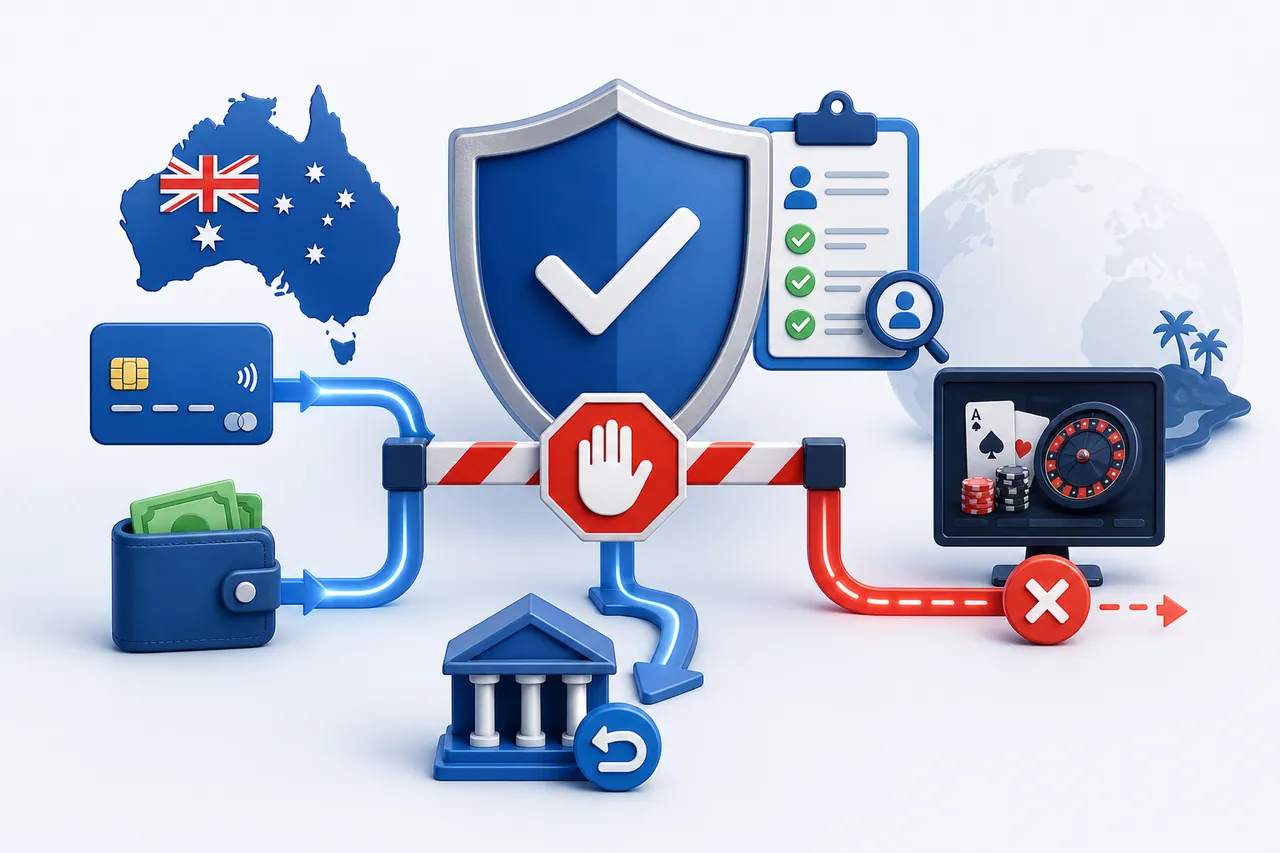
Australia is a legal-screening page, not a casino payment ranking
ACMA's current guidance says the Interactive Gambling Act 2001 makes it illegal for providers to offer certain online services to people in Australia, including online casinos. Because the service itself is prohibited, comparing “best Australian casino deposits” as if operator legality were settled would mislead the reader.
The useful decision is simpler: identify the service category, check ACMA's official information, and keep money away from an operator that cannot establish lawful Australian availability. Payment convenience is irrelevant when the platform sits on the wrong side of that first check.
- calls offshore licensing proof of Australian authorization;
- uses card or wallet acceptance as a substitute for an ACMA check;
- changes domains after a block or redirects to a mirror site;
- asks for crypto, vouchers or another deposit to unlock a withdrawal;
- cannot explain the legal entity receiving the payment.
Use ACMA to identify the service before choosing a payment method
Online casino, online wagering and lottery services do not share one legal treatment.
For wagering, use ACMA's register of licensed interactive wagering providers.
Review ACMA's blocked websites and current enforcement information.
A foreign regulator, polished payment page or Australian-dollar balance is not the same as Australian authorization. For wagering services, the provider must appear on the relevant register. For online casinos, ACMA's public guidance identifies the category as banned from being offered to people in Australia.
Why a successful casino deposit proves almost nothing
Payment networks process transactions using their own controls, merchant information and issuer rules. Those systems do not replace ACMA's legal classification of the gambling service. A card authorization only says that the transaction reached an approval state; it does not certify the operator, promise a withdrawal or create Australian consumer protection.
The same separation applies to bank transfers, wallets, prepaid vouchers and cryptocurrency. A method can move money successfully while the underlying operator remains prohibited, unlicensed for the relevant service or difficult to pursue from Australia.
| Claim shown by a site | What it may show | What it does not prove |
|---|---|---|
| “AUD accepted” | The cashier can display or process Australian dollars. | That the service is legal to offer in Australia. |
| “Visa accepted” | A card transaction route may be configured. | That the issuer will approve it or that payouts return to the card. |
| “Licensed offshore” | The operator claims authorization somewhere else. | Australian authorization or access to local complaint protections. |
| “Fast withdrawal” | A marketing statement about one part of the route. | Approval, delivery timing or recoverability of funds. |
Payment patterns that make an illegal operator even riskier
Merchant names that do not match the casino
A different billing descriptor is not automatically fraud, but an unexplained merchant name makes disputes and transaction tracing harder. Save the cashier screen, receipt and descriptor before contacting the bank.
Crypto-only or voucher-only funding
Irreversible or deposit-only routes reduce recovery options. The risk rises when the operator refuses bank or card withdrawals, changes wallet addresses or asks for an additional “verification deposit.” Never send more money to unlock money already shown in an account.
Domain hopping after blocks
ACMA publishes information about blocked illegal gambling websites. A service that repeatedly moves customers to new domains is not offering extra resilience; it is weakening the trail between the player, merchant and transaction.
Withdrawal documents requested only after a large deposit
Identity checks are normal in regulated payment journeys, but the operator should explain them before withdrawal. A site that accepts repeated deposits and reveals impossible or constantly changing requirements only when money is requested creates a serious payment risk.
Licensed online wagering has different payment rules
Online wagering is a separate category from online casino gaming. ACMA provides a register for licensed interactive wagering providers and states that, from 11 June 2024, credit cards and digital currency cannot be used to place bets with these licensed online wagering services.
This distinction matters for searchers who use “casino,” “betting” and “gambling” interchangeably. A payment method allowed for one service category does not make another category lawful. Check the product first, then the provider, then the payment route.
What to do after an unrecognized or disputed gambling payment
- Stop further payments. Do not send a second deposit, tax or release fee.
- Preserve evidence. Save the URL, account screen, cashier terms, messages, receipts and bank descriptor.
- Secure the payment account. Change compromised credentials and review connected cards, wallets and bank access.
- Contact the provider promptly. Explain whether the transaction is unrecognized, duplicated, misdescribed or connected to an undelivered withdrawal.
- Use the official route. ACMA explains how to report illegal services and make relevant complaints.
A chargeback or transfer recall is not guaranteed and depends on the method, facts and provider rules. Give the bank accurate information; do not describe an authorized gambling deposit as unauthorized simply because the gambling result was a loss.
Use payment controls before risk becomes a transaction
Card and bank blocks
Ask the bank whether gambling merchant controls, transaction alerts or card freezes are available for your account.
Separate spending limits
Keep gambling-related spending inside a fixed entertainment budget that does not affect bills, savings or credit.
Account alerts
Enable immediate notifications so an unfamiliar descriptor or duplicate attempt is visible quickly.
Self-exclusion
For licensed Australian wagering, BetStop provides a national exclusion route; broader help is available through Gambling Help Online.
Do not compare PayID, cards or wallets until the service passes the legal screen
Australia's payment decision begins differently from the US or Canada. ACMA states that online casinos are among the prohibited interactive gambling services under the Interactive Gambling Act 2001. It also maintains information about blocked websites and a register for licensed interactive wagering providers. These categories must not be blended: a licensed wagering service and an online casino offering prohibited casino-style games are not the same product.
That distinction changes the purpose of this page. It does not rank Australian-facing online casinos or offer payment workarounds. It helps a reader recognize why a fast domestic payment can still lead to an unlawful or high-risk destination, how to pause before sending, and which records matter if money has already moved.
- Identify the service category.Is the site offering licensed wagering, a permitted lottery product or prohibited online casino-style games? Use ACMA's current descriptions.
- Check the exact operator.For wagering, match the brand and provider to ACMA's official licensed register. A foreign licence or Australian payment option is not an Australian wagering licence.
- Search the blocked-site information.A blocked domain can signal enforcement and creates an immediate account-access and balance-recovery risk.
- Verify the payment recipient.Compare the PayID name, card descriptor, bank beneficiary or wallet merchant with the disclosed legal entity or processor.
- Stop on conflict.If the service category, operator identity or recipient cannot be reconciled, do not send money and do not try a different rail to defeat the warning.
A cashier accepting AUD, an Australian mobile number, a local bank transfer or PayID does not establish legality. Payment acceptance is a technical event, not a regulatory approval.
PayID shows a name before sending—use that pause
Australian Payments Plus explains that a PayID can be a mobile number, email address, ABN or organisation identifier linked to a bank account. When a payer enters the PayID, online banking displays the name linked to it before confirmation. That name check is valuable because casino scams often depend on urgency, changing recipients or a payment instruction sent through chat.
The name does not prove the gambling service is legal. It only helps the payer see who is registered to receive the bank transfer. Compare it with the operator's disclosed entity or an identified payment processor. If the cashier says one company, the bank shows an unrelated individual and support demands immediate payment, stop.
Australian Payments Plus now warns about “scambling”: illegal online gambling platforms advertised through social or messaging channels that direct people to scam sites and request PayID transfers. AP+ says PayID itself will never contact users, ask for money to receive money or require an account upgrade. Those messages are scams, not casino verification steps.
| Signal | What it means | Action |
|---|---|---|
| Recognizable business or disclosed processor | The recipient may match the documented route, but legality is still separate | Complete the ACMA check before considering payment |
| Unrelated personal name | The payment may be going to a money mule or undisclosed intermediary | Do not send; capture the instruction and report suspicious activity |
| New PayID after a failed attempt | The recipient route is unstable or being rotated | Stop rather than cycling through recipients |
| Fee to release a withdrawal | An advance-fee scam pattern | Do not pay; contact the bank and preserve the demand |
| PayID “upgrade” message | AP+ states PayID will not request this | Treat the message as fraudulent |
A working payment can outlive access to the casino account
ACMA can ask Australian internet service providers to block sites involved in serious breaches, including prohibited online casino services and unlicensed regulated wagering. A player who deposits shortly before a block can face a practical problem that has nothing to do with network speed: the casino balance exists on an account the player may no longer be able to access normally.
Do not treat a block as a prompt to find a mirror domain, VPN instruction, new crypto address or replacement PayID. Those routes can expose the player to impersonation and make the payment trail harder to establish. Preserve the original URL, account identifier, transaction records, withdrawal requests and support correspondence. Use ACMA's information, contact the bank or provider and seek independent legal advice where a material balance is at risk.
Build a dated evidence sequence
- Exact domain and time accessed
- PayID, beneficiary, card descriptor or wallet address
- Bank receipt and transaction reference
- Casino account ID and balance record
- Withdrawal request and status history
- Support demands, especially requests for another payment
- ACMA block or warning information checked
Licensed wagering payment rules do not create an online-casino exception
Australia permits certain licensed interactive wagering services under state or territory licences and federal rules. ACMA states that from 11 June 2024 credit cards and digital currency cannot be used to place bets with licensed online wagering services. That rule belongs to the wagering category. It should not be rewritten as evidence that an online casino becomes lawful when it accepts debit, PayID or another non-credit method.
This is a common SEO failure: a page combines sportsbook, lottery, poker, online slots and casino table games in one “Australian casino payments” table. The legal category changes the answer before fees or speed are relevant. Our page keeps those boundaries visible so readers do not mistake a payment option used by a licensed bookmaker for permission to fund prohibited casino-style games.
Licensed wagering question
Is the provider on the applicable official register, is the exact product permitted, and does the payment method comply with current wagering rules?
Online casino question
ACMA identifies online casinos as prohibited services. Do not use a working payment method as a route around that legal conclusion.
What to do after a suspicious or disputed Australian gambling payment
Act quickly, but keep the sequence disciplined. Contact the financial institution that holds the account, describe the payment honestly and ask which fraud, mistaken-payment or dispute process applies. A PayID transfer, card payment and crypto transfer have different recovery mechanisms; none should be promised as automatically reversible.
Secure the bank and email accounts if credentials or one-time codes were exposed. Change passwords through the official bank application or website, not through a link supplied by the casino. Report the service or advertising through ACMA where relevant. If the payment recipient appears fraudulent, follow the bank's instructions and the appropriate police or Scamwatch reporting path.
Recipient name changed on the second attempt
The player stops, saves both instructions and contacts the bank. A rotating recipient is not a reason to keep trying until one transfer clears.
Unknown merchant descriptor appears
The player matches the amount and time against the casino receipt, asks the issuer to identify the merchant and reports an unrecognized charge promptly.
Site asks for tax or unlocking payment
The player does not send more money. The demand is preserved as evidence and the account, operator and payment recipient are reported through appropriate official channels.
The best payment decision can be not to transact
In many country pages the final comparison chooses between a bank route, wallet or card. Australia requires a stronger answer. When the service is an online casino prohibited under current ACMA guidance, when the domain is blocked, when the PayID recipient is unexplained or when support asks for another payment to release funds, the best payment method is none.
That verdict is not cautious filler. It directly answers the long-tail searches large casino-ranking pages often avoid: whether a PayID casino request is safe, why a bank transfer can succeed to a risky destination and what evidence gives the player the best chance of resolving a problem. The payment rail should be used as a control point, not as proof that the destination deserves trust.
Do not route around a bank decline, site block or recipient warning
A declined Australian gambling payment can indicate an issuer control, merchant-category restriction, fraud signal, insufficient funds or a service the bank does not want to process. The safe response is to identify the reason. It is not to send the same amount through PayID, buy a voucher, open a crypto wallet or use another person's account simply because those rails might avoid the original control.
The same rule applies to blocked domains. A mirror link or new app may restore access to a similar interface while changing the legal entity, payment recipient and evidence trail. Depositing through that replacement can deepen the loss if the original balance is already disputed. Preserve the old account and transaction records, consult ACMA information and contact the bank or provider through official channels.
Ask for the category
Confirm whether the issue is account balance, transaction security, merchant policy or another named cause. Do not request concealment.
Protect the evidence
Save the original domain, balance, transactions and support messages. Do not follow unsolicited recovery links.
Trust the bank display
An unexplained recipient name or payment-upgrade message is a reason to stop, not a minor checkout inconvenience.
Never pay to unlock
Taxes, verification and fees should not arrive as a demand to send money to a new personal account before funds are released.
This position deliberately avoids a common competitor pattern that treats every payment block as friction to overcome. For Australian readers, refusing the transaction can protect more value than finding a faster rail.
Official Australian sources used for this guide
- ACMA: About the Interactive Gambling Act — service categories and prohibited online services.
- ACMA: Check if a gambling operator is legal — licensed interactive wagering register.
- ACMA: Blocked gambling websites — blocked illegal services and the basis for blocking.
- Gambling Help Online — confidential Australian support and information.
- ACMA: Online gambling services — current service categories and consumer safeguards.
- ACMA: Protect yourself from illegal operators — payment and withheld-funds risks.
- Australian Payments Plus: PayID — recipient-name checks and the scambling warning.
- Australian Payments Plus: PayID FAQs — processing, limits, security and scam guidance.
Legal and regulator details were reviewed on July 19, 2026 and should be checked again before publication updates.
Australia casino payment FAQ
Are online casinos legal in Australia?
ACMA states that online casinos are among the banned services under the Interactive Gambling Act 2001. Use current ACMA guidance for the exact scope.
Does an approved deposit mean the casino is legal?
No. Payment processing and operator legality are separate. A card, wallet or bank approval is not an Australian licence.
How can I check a gambling operator?
Use ACMA's official information. Its register applies to licensed interactive wagering providers; online casinos are a prohibited service category.
What should I do after an unrecognized gambling payment?
Contact the bank or payment provider promptly, preserve records, secure the account and use ACMA's reporting routes where relevant.
Can credit cards or digital currency be used for Australian online wagering?
ACMA states that licensed online wagering services cannot accept credit cards or digital currency for bets from 11 June 2024. That is a wagering rule and does not legalize online casinos.