
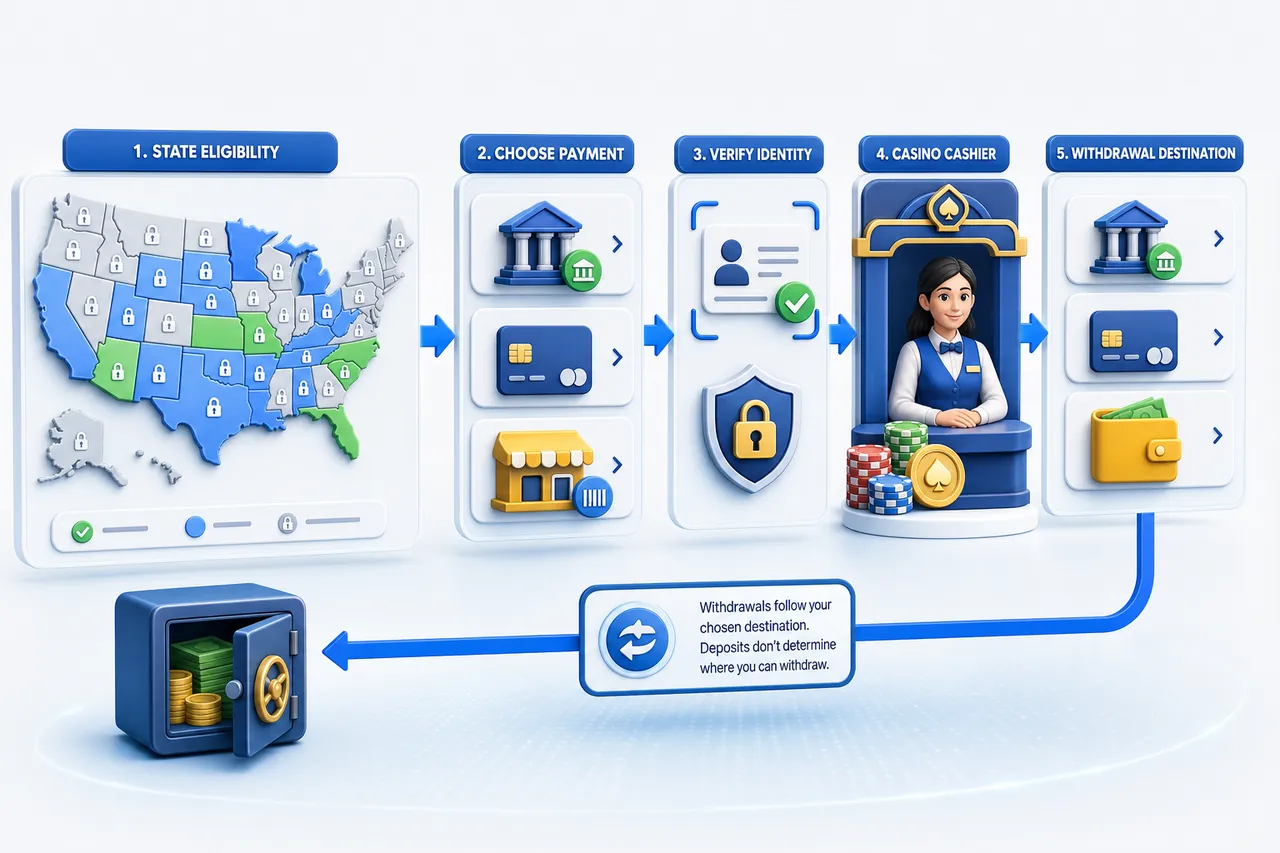
Choose the payout route before pressing deposit
A US cashier can show several familiar logos and still leave only one sensible withdrawal option. Start with the withdrawal menu. If a verified bank route is available for both directions, it usually gives the clearest ownership trail and the fewest handoffs. If you prefer a card, wallet or retail cash deposit, identify the fallback payout account and its KYC requirements before funding.
- Confirm that the operator is permitted for your physical state.
- Open both the deposit and withdrawal menus.
- Compare names, limits, fees and supported currencies.
- Check whether the receiving account must be verified first.
- Save the cashier terms that apply before the transaction.
US casino deposit and withdrawal method comparison
These are route-level expectations, not a promise that every operator or state supports the method.
| Method | Deposit role | Withdrawal role | Best fit | Watch for |
|---|---|---|---|---|
| eCheck / ACH | Direct bank funding | Often the most natural bank payout route where offered | One account for both directions | Bank verification and casino processing time |
| Debit card | Fast and familiar where the issuer accepts gambling transactions | Card payouts are operator- and network-dependent | Simple deposits | Declines and deposit-only card support |
| PayPal or wallet | Fast account-based funding where visible | Can receive payouts when enabled by the operator | Separating casino activity from the main bank interface | Wallet availability and account-name matching |
| PayNearMe | Retail cash funding | Normally requires another payout route | Players who prefer cash deposits | Deposit-only setup and store limits |
| Cash at cage | Venue-based funding where offered | May support in-person collection | Eligible players near the venue | Identification, travel and collection rules |
US availability is decided state by state
A payment logo is not a legal signal. US online casino availability is state-specific, and geolocation is part of the account journey. A bank or card approval only confirms that one transaction passed; it does not prove that the operator is authorized where you are physically located.
Use the relevant state regulator or the American Gaming Association's state-by-state map as a starting point, then confirm the operator on the official local directory. Do this again if you travel, because account access and payment eligibility can change with physical location.
eCheck and ACH give the strongest two-way structure
eCheck and ACH connect the casino account to a bank account in the same player's name. That direct relationship makes them easier to understand than a voucher-to-wallet-to-bank chain. In our route review, bank methods are the first option to inspect when the priority is a predictable withdrawal destination rather than the fastest-looking deposit button.
The tradeoff is timing. A casino may show the deposit balance quickly while the underlying bank transfer is still moving, and a withdrawal can remain pending during operator review before the banking rail begins its part. Keep casino approval time separate from network delivery time when comparing “fast payout” claims.
Cards, wallets and cash each solve a different problem
Cards are convenient, not automatically two-way
Debit cards are familiar and can confirm quickly, but issuer policy and operator configuration control acceptance. Check the withdrawal menu for a card payout option instead of assuming funds can return to the card. Credit availability and rules also vary, so the cashier and issuer terms matter more than the card logo.
Wallets reduce handoffs when both directions are enabled
An eligible wallet can create a clean deposit and payout route, especially when the wallet account and casino account share the same verified identity. The decisive detail is not wallet speed in isolation; it is whether that wallet appears in the actual withdrawal menu for your state and account. For the tokenized-card route, use the dedicated US Apple Pay casino guide to check state authorization, debit-card eligibility and the withdrawal destination.
Retail cash is a one-way funding choice
PayNearMe can be useful for cash-based funding, but the cash receipt does not become a digital withdrawal account. Plan ACH, a supported wallet or an operator-approved collection route before depositing. Without that plan, a convenient cash deposit can create the least convenient payout journey.
US casino withdrawal speed has three separate stages
The operator checks balance rules, account status and any open verification task.
The cashier releases the payout to the selected bank, card, wallet or collection route.
The receiving network and financial institution complete the transfer.
A method described as instant can only describe one part of this chain. Compare the operator's pending period, document review and network delivery separately. If a site advertises guaranteed instant withdrawals without defining those stages, treat the wording as a payment red flag.
KYC, account names and failed payment fixes
The casino account, bank account, card and wallet should belong to the same person. Name, address or date-of-birth mismatches can trigger manual review. Third-party deposits can also complicate refunds and withdrawals because the operator may need to establish ownership before releasing funds.
If a deposit is declined
- Read the cashier error before trying the same transaction again.
- Confirm state and geolocation eligibility.
- Check the amount against the operator and bank limits.
- Verify that billing details match the payment account.
- Ask the issuer whether the transaction category is blocked.
Do not keep retrying rapidly or open multiple payment accounts to force approval. That pattern can create duplicate holds and a more complicated verification trail.
Who should choose which US casino payment route?
Choose eCheck or ACH if…
You want a bank-owned route that may support both deposits and withdrawals and you accept that bank processing is not always the fastest stage.
Choose a wallet if…
The same wallet is visible for both directions and you want a separate interface between the casino and your main bank account.
Choose a debit card if…
Deposit convenience is the priority and you have already confirmed the actual payout method.
Choose PayNearMe if…
You specifically need cash funding and already have a verified digital or venue-based withdrawal plan.
Use a six-question US cashier check instead of a static state list
US internet casino availability is not a national setting. The relevant state decides whether regulated online casino play exists, which operators may serve players and which complaint route applies. A national payment brand can work for ordinary purchases in every state while appearing in a regulated casino cashier only where the player, operator and payment account pass local checks.
A static “accepted in all states” table ages badly because launches, operator contracts and cashier vendors change. The safer and more useful process is to verify six facts in order: physical location, operator authorization, account identity, deposit menu, withdrawal menu and provider ownership. If any answer is missing, stop before funding.
- Confirm physical eligibility.Use the relevant state regulator or official legal-operator directory. Registration from another state does not prove the player can wager from the current location.
- Match the exact domain or app.Compare the operator name and digital property with the official listing. Similar names, search ads and payment-processor descriptors are not substitutes.
- Complete the account identity.The legal name, date of birth, address and taxpayer or identity details must match the regulated account requirements before a payout can be treated as routine.
- Open the signed-in deposit menu.Record which methods appear for this player rather than relying on a public banking page.
- Open the signed-in withdrawal menu.Identify the receiving account, minimum, maximum, review status and whether a recent deposit is required to activate the route.
- Name the payment owner.Use a personal bank, wallet or prepaid account controlled by the verified player. Do not use a friend, spouse or business account as a shortcut.
Keep the state regulator listing, cashier menus, deposit confirmation, bank or wallet statement, withdrawal request and support case number. These records connect the casino event to the payment rail if a transaction needs to be traced.
ACH is the strongest US default when the credit route is enabled
ACH is the network behind many electronic bank debits and credits in the United States. A casino may label the experience eCheck, online banking, instant bank payment or ACH. The label describes the customer interface; the underlying transfer and the operator's processor determine authorization, settlement, returns and trace information.
At deposit, the player may enter routing and account numbers or connect through a bank-authentication provider. The casino or its payment partner originates a debit after receiving authorization. Some interfaces credit the gaming balance before final bank settlement, so a visible casino balance does not always mean the bank transfer is irreversible. Insufficient funds, account restrictions or a returned debit can still affect the account.
At withdrawal, the direction changes. The casino approves the request, its processor originates a credit and the receiving bank posts the funds. Nacha explains that ACH credits may settle the same day, next banking day or in two banking days, with most settling in one banking day or less. That network statement begins after a valid credit enters the network; it does not measure casino review, KYC or a weekend request waiting for operator action.
| Stage | Deposit direction | Withdrawal direction | Best evidence |
|---|---|---|---|
| Authorization | Player authorizes a bank debit | Casino authorizes a payout after review | Consent screen or approved withdrawal record |
| Originator | Casino or processor sends the debit instruction | Casino or processor sends the credit instruction | Processor name and transaction reference |
| Bank event | Account is debited or the debit is returned | Receiving account is credited or rejects the entry | Bank posting date and ACH trace details |
| Failure response | Read the return reason before retrying | Ask the sender to trace or correct the destination | Support case plus bank confirmation |
Do not repeatedly submit a failed bank debit. Multiple attempts can create duplicate pending items, repeated return fees or a risk review. Correct the routing number, account type, available balance or ownership mismatch first. If the casino says a withdrawal was sent, request the ACH trace or processor reference and give it to the receiving bank.
Play+ and e-wallets are accounts, not magic instant-payment buttons
A branded prepaid account such as Play+ can be valuable when it accepts both casino deposits and casino payouts. The important comparison continues after the casino balance reaches the prepaid account. Ask how funds move from that account to an ordinary bank, whether an ATM or card-spend option is needed, which fees apply and whether an inactive account carries a charge.
PayPal, Venmo or another enabled wallet can shorten the visible cashier flow and keep bank details one step away from the operator. The wallet must still belong to the verified player, use a compatible email or mobile identity, and support gambling transactions in the relevant regulated market. A familiar wallet appearing at deposit does not guarantee that the withdrawal button will appear before identity checks or a qualifying deposit.
Choose ACH/eCheck
Best when the player wants a direct bank destination, suitable limits and one auditable ownership trail. Accept that operator review and banking days remain separate.
Choose Play+
Best when the casino-branded account receives payouts and the later bank-transfer, ATM or spending cost is understood before deposit.
Choose a wallet
Best when the same wallet is available in both menus and the player values a separate interface between the casino and primary bank.
PayNearMe and cards need an exit plan before the first dollar moves
PayNearMe-style retail cash funding can solve a specific access problem: the player generates a barcode, pays at a participating location and keeps the receipt. The route is deliberately one-way. The store cannot receive online casino winnings on the player's behalf, and the barcode is not a reusable bank account. Confirm a same-name ACH, wallet, prepaid or approved venue-based withdrawal before paying cash.
Debit cards offer the most familiar deposit experience, but issuer acceptance can change by merchant category, state, operator and risk controls. Credit-card use can introduce cash-advance treatment, interest or issuer restrictions and should never be presented as borrowed bankroll. If a card deposit fails, read the message, check the amount and billing details, contact the issuer when appropriate and choose a legitimate supported alternative. Do not disguise the transaction, rotate cards or send funds to an individual.
Debit succeeds, payout menu omits the card
The player does not make another card deposit. They verify an ACH or wallet destination in the same name, ask how the original deposit value is returned and save the operator's allocation explanation.
Retail cash receipt is missing
The player contacts the retail payment provider and store with the barcode, time, location and amount. They do not buy a second barcode to “activate” the casino balance.
ACH withdrawal is marked processed but absent
The player confirms the receiving account, asks the casino for the trace reference and initiation date, then asks the bank to locate the incoming credit.
Build a US payment record that a bank, operator or regulator can follow
A useful complaint is a timeline, not a folder of unexplained screenshots. Record the account holder, state, operator domain, payment method, amount, time zone, transaction status and the exact outcome requested. Separate operator review from network delivery so the receiving institution knows whether it is looking for a payment that was actually sent.
- Identity layer: verified account name and masked destination details.
- Eligibility layer: official state operator listing and location confirmation.
- Deposit layer: cashier receipt, bank posting and any return reason.
- Withdrawal layer: request time, approval time, initiation time and trace reference.
- Communication layer: support transcript, case number and promised next action.
Attempt to resolve the issue with the regulated operator first and preserve the written response. For example, the Michigan Gaming Control Board instructs players to submit a written complaint to the provider before escalating a patron dispute. The exact process depends on the state, which is another reason the state gate belongs at the beginning of the payment decision.
Changing the US payment method should solve a documented cause
A new payment method is not automatically a better payment method. Switch only after identifying why the first route failed. If a debit card was declined by the issuer, ACH may work because it uses a bank-account authorization instead of a card purchase. If ACH failed because the account name does not match, moving to a wallet with the same mismatch will not solve the ownership problem. If PayNearMe funded the balance successfully, another cash deposit cannot create a withdrawal destination.
Before switching, cancel or allow any pending attempt to resolve, record the failure code and ask whether duplicate transactions are possible. Then verify the replacement in the signed-in withdrawal menu. The best replacement keeps the same player identity, avoids borrowed funds, supports the intended amount and produces a traceable receiving event.
Card to ACH
Reasonable when the casino supports a verified bank connection and the bank account belongs to the player. Do not ask the issuer to misclassify the merchant.
Cash to wallet
Reasonable only when the operator approves the same-name wallet as the payout route before additional funding.
Stop and correct
Update legitimate account details through official support. Do not rotate payment accounts until one passes.
This cause-based approach answers a valuable long-tail problem—“which US casino payment method should I try after a decline?”—without teaching readers to evade controls. It also preserves a clean record if the operator or bank later reviews the account.
Official checks before funding a US account
- American Gaming Association State of Play map — use it to identify the relevant state framework, then follow the state regulator.
- PayMethod Guide review methodology — how we separate legal evidence, cashier observations and payment-network timing.
- National Council on Problem Gambling help and treatment — current US support options.
- Nacha: What is ACH? — official explanation of the US ACH Network.
- Nacha: How ACH payments work — credits, debits and settlement timing.
- Michigan Gaming Control Board: legal operator information — an example of a state-level verification source.
- Michigan Gaming Control Board: patron disputes — written operator complaint and escalation workflow.
US casino payment methods FAQ
What is the best casino payment method in the US?
For a complete route, a supported eCheck or ACH option is usually the strongest starting point because it connects deposits and potential withdrawals to a verified bank account. The best choice still depends on the state and operator cashier.
Can I withdraw to the same card used for a deposit?
Only when the operator and card network support card payouts for that account. If the card is deposit-only, the cashier may require ACH, a wallet or another verified route.
Is PayNearMe a casino withdrawal method?
PayNearMe is primarily a retail cash deposit route. Plan another approved method for the withdrawal before using it.
Why does a US casino deposit get declined?
State eligibility, issuer rules, insufficient funds, mismatched details, limits and unsupported payment routes are common causes. Read the error and correct the cause before retrying.
Does payment acceptance prove that a US casino is legal?
No. Check the state regulator or official state-specific directory. A successful payment is not proof of authorization.